6 d’ag. 2016

paréntesis 15


Miras al suelo mientras andas, por costumbre y por no tropezarte. Cada ciudad tiene su forma de caminar. La calle está fracturada como un espejo roto, había habido bordillos que ahora están erosionados en algunos tramos y se han derrumbado en otros. Había habido también asfalto que ahora se desmorona de vez en cuando por sorpresa como la arena por el cuello del reloj. Desaparecen partículas de calle hacia el vacío de la ciudad granulada, y por eso hoy caminas mirando al suelo, por instinto y por si acaso. 
 
Te encuentras entre un paso y el siguiente con un gato minúsculo a quien ya no le asusta el cerco de pies a su alrededor. Sorteas algún que otro montón de basura y haces como si no estuviera, los trajo la tormenta y se quedaron por desidia. Calles que supuran basura, acné urbano en una ciudad que crece, crece, crece. Casi nunca andas por la acera. Haberlas haylas, pero siempre terminas haciendo equilibrismo entre la carretera y los coches aparcados. Cada ciudad tiene su forma de caminar. En la tierra de nadie que trazan las sombras de los coches en doble fila y los coches a toda leche se anda mejor. A veces algún charco, a veces algún susto. Y de vez en cuando, calles de polvo tan estrechas que los edificios las envuelven con su celofán de balcones y ropa tendida. Sólo una cuchillada de cielo para que corra el aire y se meneen las sábanas y los calzoncillos blancos. 

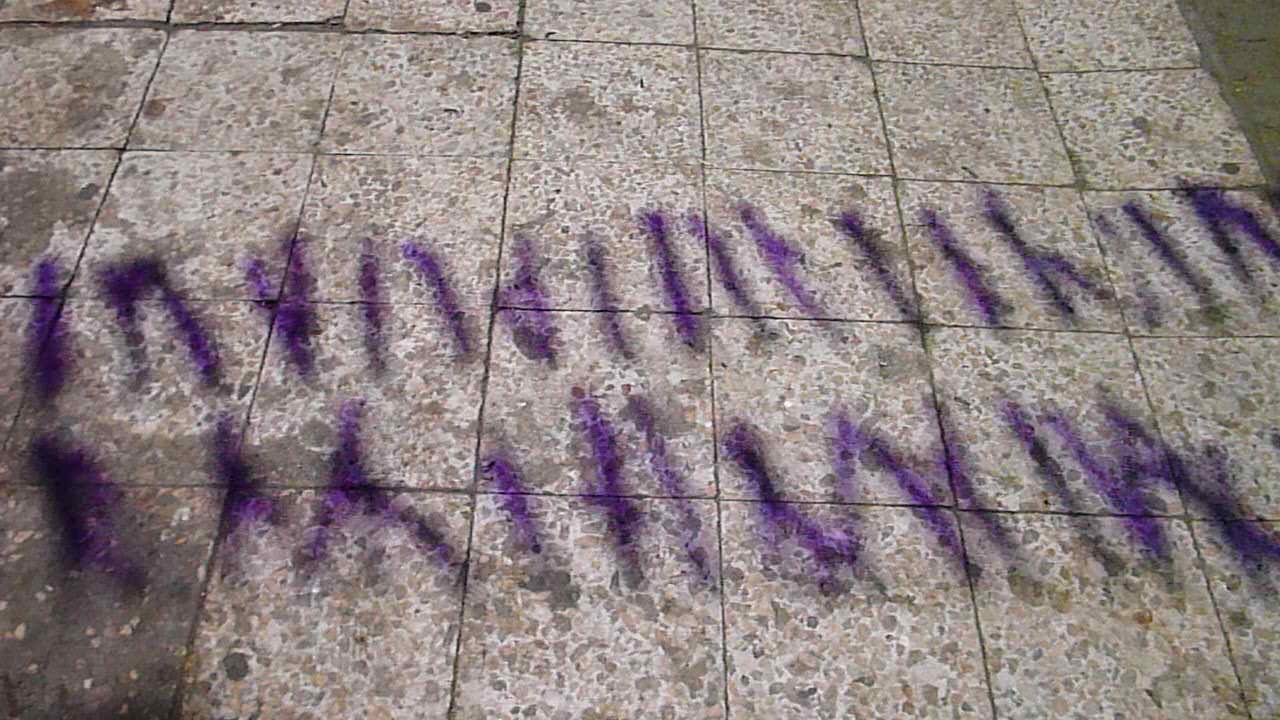
Al doblar la esquina, antes de que el gentío la devore, una caricia violeta en los adoquines nos recuerda que hay cosas que celebrar. Un collar de reflejos violetas hace bailar las banderolas que engarzan un lado de la calle y su opuesto, residuos de plástico del penúltimo ramadán siguen decorando la calle hasta que el sol se los coma o hasta que se los lleve el viento. 
 
Caminando como se camina en estas calles, se ve primero la sombra de casi todo, hasta de lo bonito. Y la sombra de estos vestigios de celebración parece un mapa de cromosomas coloridos, con sus patitas de X y sus patitas de Y saltando entre los rascacielos. Se balancean tan rápido que el viento se lleva la afinación norte-sur de la brújula, por eso seguimos desorientados aunque tengamos el mapa tatuado en el suelo. 
 
Cada ciudad tiene su forma de caminar.
 

Parenthesis 15


You look at the ground as you walk, out of a habit and out of precaution. Each city has its own way of walking. The street is fractured as a broken mirror, there had been curbstones which are currently eroded in some sections, some others have crumbled. There had also been asphalt, and it's moulding by surprise every now and then as the sand goes through the neck of the clock. Street particles disappearing in this granulated city, and this is why you walk staring at the ground, by instinct and just in case. 
 

Between one step and the next you meet a tiny cat who is not afraid of the besieging steps around. You raffle some pile of garbage and pretend it's not there, it came with the storm and stayed out of sloth. Streets suppurating trash, urban acne in a city that keeps growing, growing, growing, You rarely walk on the sidewalk. There are sidewalks of course but you always end up juggling between the road and the parking line. Each city has its way of walking. And we walk better in the no man's land drawn by the shadows of the double layer of cars and the cars at full speed. Sometimes a puddle, sometimes a fright. And sometimes, streets of dust so narrow that are wrapped by buildings with its cellophane of balconies and hanging clothes. Just a wound of sky to let the air blow and toss the bedsheets and the white underwear. 
 
Round the corner, about to be devoured by the crowd, a violet caress on the cobbles reminds us that there are things to celebrate. A neckless of purple reflections keeps the dance of the banderoles while linking one side of the street and its opposite, plastic remains of the previous ramadan keep decorating the street until the sun will eat them or the wind will take them. 
 
Walking the way we walk these streets, first we see the shadow of almost everything, even beauty. And the shadow of these celebrating remains looks like a map of colorful chromosomes, with its tiny X legs and Y legs jumping between the skyscrapers. They swing so quick that the wind takes the tune of north and south away from the compass, this is why we stay disoriented although the map has been tattooed on the ground. 
 
Each city has its own way of walking.


27 de març 2016

how not to be myself


Something that tries to escape, as a continual departure,
to loosen the seams, but also which seeks to find connection, to be heard.
Sound as an unsteady economy of the between. In this way, sound teaches me how not to be myself.
Brandon LaBelle 1


1.
Outdoors, late afternoon. Street vendors, cars up and down, families shopping and kids yelling. Urban life in action on a friday afternoon, apparently random and intimately organized. Let's say that I propose you to stand next to the man who sells jeans and to pick one of the characters in this imaginary scene. Do you have it? Who is it the mother of three or the book seller or the teenager with a bike?
Let's sit in the café round the corner. You'll be staring at the wall and I will ask you to describe for me what this character might be doing. I'm sure your blind guessing will be right. Because you have seen this street thousands of times, you know how to walk in it, where to buy cigarretes by unit and whose eyes you should avoid. This conforms to a rough and ready balance where whoever is in control of the portion of space becomes the rightful arbitre of what weaker others get to hear or see2
I have left you alone sitting in the imaginary café staring at the wall and the guys in the tables around start muttering jokes about how weird you look, two girls pass by the table and comment on your clothes and the waiter asks you about the woman who has just left without warning. You might have thought that you were alone, but you weren't. Out in the street, late in the afternoon you are accompanied by a crowd of others who know who you are not. And have an opinion about who you should be.


2.
Mashroua, morning. Pop-up message in the phone: I'm sorry for the last time, I left you waiting in a fictional café. Do you have any plan this afternoon? Let's meet at the tram station for a walk. You are a bit late but it's fine, arriving a bit late is a way of breathing. I didn't tell you, but we won't be alone.
Close your eyes. Let's walk. Someone will hold your hand and you will walk the sound. At first you will be worried about whose hand are you touching, the texture of the skin, the strenght of the wrist, the touch of the elbow against your arm. Then you will notice the smell of this other someone walking with you. Is it parfume or deodorant? Is it the scent of a he or a she? And then you will stumble on some obstacle at your feet. And the someone will hold your hand a bit harder and you will consider opening your eyes and put and end to this game.
But you hear the clinging sound of a bell, a horse charriot maybe or a juice seller. The body who guides you slows down and you are a bit dizzy because you don't know what's around you and you can't predict what could happen. But the challenge for this exercise is that no matter how slow you are walking, you can always go much slower3.
The air is cold and accelerates as a harsh loud sound passes by your left side. You don't move because a stanger is holding your hand and is not giving you any sign to go forward. After a while the stanger will touch the palm of your hand and you will resume the walk, and some voices will approach you and you will hear them wondering wether you are blind or stoned. You cannot see the stranger but you can tell that he or she is smiling just like you are now. Because you share a secret, you are listening to the shapped air between you and I and the city and these voices are just a detail of its sound. 
 
3.
Tramway station. Afternoon. A voice whispers in your ear “you can open your eyes now”.
It will not be me that you will find standing next to you. Your intuition was right, someone you don't really know has been finding noises for you. Together you have composed a space built with spare pieces of wind and horns and men's voices and rushed steps and humming leaves and smell of smoke.
Your eyelids feel heavy and your lungs are open, the breathing has found its way to participate in this partition and now it's your turn to pick the sound you want to share, knowing that sound is ungovernable, that is, it is at one and the same moment, yours and not yours4.
I will close my eyes and I will stand in the street. Someone, maybe you, will hold my hand and we will draw the streets again. The feeling is somehow subversive because we are inventing the shape of a space we thought we knew. It is sound itself, as pathetic trigger, that entices us to inhabit this world in listening, and grants us access to what the world might be5.
This afternoon we are out in the street alongside with few strangers walking slowly exposing our vulnerable bodies to the urban rush, daydreaming, soundwalking. Experiencing a way of being related to what is not me and not fully masterable (…) a kind of relationship that belongs to that ambiguous region in which receptivity and responsiveness are not clearly separable from one another 6


4.
In bed. Late night. Your inner voice tries to identify the streets we have been walking in today and you don't know how to link the bell with the horse or the voice with the face or the smoke with the café. And when you are about to fall asleep, your body reaches the weight of the dream and tells you that it is not important, because your ears and the stranger's hands have drawn a map of possibilities in a city where the impossible is narrowing by the day.
Together we have questioned that terrible weight of the official reality that says: there is what there is. And so we could breathe. The macro situation remains the same, but now we see it from another place. It's all horrible, but at the same time we have proven ourselves capable of producing another reality. And that automatically generates joy, a new emotional climate7.
Tomorrow I will pass by the imaginary café. I will be a bit late and you will be sitting alone with a glass of tea. Your eyes will be closed, your head slighly bent, a minor smile in the corner of your lips, your ears wide open. The guys in the tables around will be muttering jokes about how weird you look and two girls will pass by the table and comment on your clothes. They won't know it, but they will be witnessing the disappearing act, your vanishing self in the sounds of Alexandria.
I will sit next to you and whisper: you can open your eyes now.


* Notes based on the workshop “Experiencing a sensitive exploration of the city” with the art collective City sounds concert / Ici-Même, organized by Nassim el-Raqs in Alexandria between the 6 and 15 of november 2015.

** This article was orginally published in arabic in the cultural magazine Tar al Bahr. 

1 LABELLE, Brandon. “Lecture on an acoustics of sharing” in FISCHER, Berit and MUHLEN, Kevin. Hlysan, the notion and politics of listening. Luxembourg. Casino Luxembourg, 2014. p. 22
2 DARWISH, Hany quoted by EL-WARDANY, Haytham and MAAMOUN, Naha: “How to Disappear” in The right to silence conference curated by ABU HAMMDAN, Lawrence. Amsterdam, 20-23 march, 2014.
3 OLIVEROS, Pauline. Deep listening: A composer's sound practice. Lincoln: Deep Listening Publications, 2005. p. 20
4 RAIMONDO, Anna. “Brandon LaBelle, interviewed by Anna Raimondo”in Reflections on process in sound (2). p. 2-12: December 2013.
5 FISCHER, Berit. “On the notion and politics of listening” in FISCHER, Berit and MUHLEN, Kevin. Hlysan, the notion and politics of listening. Luxembourg. Casino Luxembourg, 2014. p. 15
6 BUTLER, Judith. “Rethinking vulnerability and resistance” conference in the XV Simposio de la Asociación Internacional de Filósofas. Madrid. Instituto Franklin - Universdad de Alcalá de Henares, June 2014. p. 16
7 FERNÁNDEZ-SAVATER, Amador. “How to organize a climate" in Making worlds: a commons coalition: 9 January 2012

25 de febr. 2016

the applause

 
What man contemplates in this scheme is the activity that has been stolen to him, it is his own essence, torn away from him, turned foreign to him, hostile to him, making for a collective world whose reality is nothing but man's own dispossession.
Jacques Rancière. The emancipated spectator.
 
 
Abu Qir street, seven in the afternoon, six lanes road. A man standing in the brick row that distinguishes the incoming from the outgoing cars. He has left a couple of plastic bags on the floor and he has rolled up his sleeves. He locates his sight on a relatively undetermined spot on the other side of the street and he applauds. Clap clap clap clap clap.

About three minutes of applause. Pause. He stretches his right arm, then his left arm, rolls his shoulders and resumes. Clap clap clap clap. On the left the faculty of engineering, on the right a hospital, on both sides cars motorbikes passersby traffic police bicycles. And a standing man who claps to a rhythm  he only knowns, lunatic metronome.

The scene repeats almost every day, almost in the same place, almost at the same time.

Almost everyone has seen him once. Even those who think they haven’t ever seen him, when asked they vaguely remember his shabby clapping profile. And when asked, almost everyone has a different story to explain his quartered ovations. A clapping man is an open question mark in the middle of the city. As in the old songs, some say his son was killed in the university. Some say he lost his job in the hospital. Some say he’s with the islamists. Some say he’s with the socialists. Some say he’s with the military. Some say he’s crazy. Some say he’s not.  What’s there left for a middle aged man to celebrate in the country of uncertainties? Where people disappear twenty by twenty and the enemies are killed thousand by thousand?

What the fuck is the clapping man clapping at? The question crumbles in the void of his palms. Clap clap clap clap.


Drinking beers with A I tell him about the applause in Abu Qir and about how it makes my day when i see the clapping man splitting normality in the traffic jam.  A switches on the warning lights bristling his eyebrows. He tells me that when Bouazizi set himself on fire in the public square back in 2010 there where voices who devoted time and words to theorize his immolation in terms of performance. Ladies and gentlemen we’ve discovered total art in times of dictatorship, with footnotes and arab springs. He adjusts his glasses and asks my opinion on the matter. Performance or what? I take a sip of beer to buy time. Well, i don’t know, i guess he’s just a clapping man but we should go more often to check how he does it.

There are poets in jail in this city. Censored movies. Shut down galleries. Charged publishers. Disappeared journalists. Tortured students. Ditched nobodies. Every time we think of doing something to give shape to what we feel, we update the bookkeeping of risks, counting interrogations as production costs. It almost never happens, but it happens. And we do less and less and it happens more and more. However a man carries his own reasons in the middle of the street for a standing ovation to this void and nobody dares to stop him.

I’m on my way back from the supermarket, I step off the bike and listen to the clapping man. I observe his gestures, tired arms, constant pace. When his applause is faces me I look at him in the eye but he doesn’t shrink. He sees me, but he doesn’t care. And i check the cars passing by, they don’t look at him but  they see him. Not a metaphor not a performance not madness. Then what? A asks. I don’t know: a parenthesis. And i clap.

Clap clap clap clap.

17 de febr. 2016

self portrait of wednesday

i'm afraid of my grandma dying
pigeons flying above the rooftops makes me smile
i have the ability of being deeply sad
and i have lived in many cities
the horizon is important to me, so is my bike
sometimes i'm scared of scared people around
and i'm proud of my living room as a shelter for friends
i don't know what will come next
my brother rarely smiles and it worries me
i love writing, but i can't dance

24 de gen. 2016

to be us


Contextualizing is not always a matter of figures and letters, contextualizing is also about filling in the gap between the letters and the headlines. Context is following the thread of those who sustain the headlines being the main characters of news that are not in the news.
Those who are not Nobody's à la Galeano, because they are I's discussing about the difficulties of living with the Other, about being People alongside other nobodies who despise each other.
What follows is a Saturday conversation about the difficulties of being Us in Egypt, when what is shared is the victory, the guilt, the defeat and the struggle.
Ezz and I live in Alexandria and we love to talk. We bridge one hour after the other, we link the words jumping from one topic to the next because there is something that Ezz is very good at: listening and answering back with an endless dwell of questions. Today we have decided to try an experiment: we'll meet in the morning to talk about our stuff, but this time we'll record it, as if it was an interview in disguise. The thing begins when Ezz rings at my door and waits for me in his wonder car downstairs. A car that has the ability to spit the right music at the right time. And the ability to be checked at every check point: wrong license, rear light broken, suspicious driver.
 

To be Myself:
M: tell me, where are we going?
E: we're going to the highway heading to Borgh el Arab. There's a big lake, lake Mariout. There's few people around and we can talk in peace, naturally.
Talking naturally is something that sometimes you have to plan in Alexandria, but it's hard to explain the reasons of this crippled spontaneity without becoming a paranoid. Being oneself implies building the spaces to be easygoing, because you feel often the eyes of others licking your neck as if they were only gossiping, as if they were controlling. So Ezz proposes to talk while he drives randomly on the way that goes from Alexandria to the lake. And ideas keep rolling as we drive up and down the road. Ezz says that he prefers to do so because if we were sitting in the city, the sight of others would stick to our words.
Ezz is young, his hair is very long and curly, he's growing his beard and wears tshirts with slogans written in many languages which are not arabic. There are plenty of guys with beards in the city and many of them have afro hair. Some of them wear challenging tshirts and, just like Ezz, rebuilt their identity around 2011 by becoming political subjects. Despite of their youth, Ezz's generation tells the story of their previous 5 years with a biographer's precision. Because, to a great extent, they are and they have become an I that walks in the streets of Alexandria.
I ask him how do the others see him and he says:
E: According to their definition I am a concept. Not a person. And you can see it in their eyes, in the way they look at you. They focus on what you wear, your way of speaking, the way you smoke, even your way of walking, the way you look at things they are not used to see. And they think you are weird because the eyes with which you look around are not like theirs.

 
To be Him:
Being oneself looks suspicious in the streets of a city where uniformity is invisible but stalks you in every corner. When you go out to the public, exposing your skin to the sunlight and to others, you cannot avoid looking for the traces that will help you distinguish who's the imaginary Other, to anticipate what he likes and what he dislikes, knowing that he's observing.
M: who is He?
E: he carries two packs of cigarettes in his hand. One pack of Marlboro and one of LM. In the other hand he carries two self-phones. A small one for business and a bigger one for his adventures, for Facebook and WhatsApp to share a lot of stuff about how strong and handsome Sisi is and about his ability to run the country. He's 30 or 35. He has a son or he's about to have one. He's married to a girl he found to be his wife after having had some relationships with other girls he now considers to be whores. But he wanted a pure woman, because he deserves a proper wife. He spends a lot of time in those cafés in Miami or Sidi Bishr, this kind of tasteless coffee shops, with no identity, merely commercial, touristic spots. Cafés that have the taste of tasteless things. He lives in a building of old Alexandria, in Mansheya for instance. He has a little tummy, grease in his hair and he has never considered doing things in a way that differs from what he has been told. He's convinced that there is an enemy, but he doesn't realize that the enemy of this society is society itself. He thinks that the enemy is always beyond. And the enemy always tries to persuade him that in order to save society you have to kill others.

 
To be the People:
But Him, this paradigmatic him, is part of the people who live among us in the same way as we mingle with the People. Although we never fully manage to be unnoticed: Him and his greasy hair, Ezz and his beard, they happen among the people knowing that you have to pay attention, because the People knows the enemy is hidden among us. This is why He is staring around trying to identify it, for the sake of our security. But being an enemy or a victim depends on the shade of the glasses through which the disperse authority sees us.
M: Who is the victim?
E: It's those people who for some reason believe that there might be a small possibility for change in society. In one way or another: to be more islamist or to be more radical. Or it might even be those who don't expect any change but who complain about the rise of the prices. They will be victims. Those who support and cheer the indiscriminate repression and the blood could be victims, any given day they can be the victims. Because in this society everyone is a victim. Everyone is a victim but we don't realize it.
When it comes to be a victim there are many shades of gray, despite of the fact that being guilty is a matter of black and white. And everybody knows it, when they stay home or when they go out to the street. When they speak about the weather, or about a TV show, or about the family. To be People is in fact to be constantly making choices and negotiating to what extent one can be oneself among others.
E: Each one has a compromise, a choice. And sometimes people choses to see an alternative, even if you pay the price with your life. This kind of commitment is the main reason why people dies attending any event. It's the only compromise that people can make, because in this country it is very difficult to say something without being hit. There is a stick for every word and a bullet for every chant. And to them, this kind of sounds have a value: if you speak during a couple of minutes, we will hit you; if you speak for more than ten minutes, you will get a life sentence. And if you speak during four years, we might kill you. It's a scale of values that people tries to understand. And when they understand it, they decide to speak out for as long as possible. And this is how they end up dead.
Being People means making noise, honking in the street jam or chanting. And in the risk of such noise raises the identity of the martyr, who is at the same time a very specific somebody and a nobody among many others.
When I ask Ezz how to make this journey that goes from the death of an “I”, that could be anyone, to the celebration of a martyr, he tells me:
E: The fact that you have been killed tells a lot about yourself. It tells us a lot because you have been murdered, and it might be a stereotype, but if the police has killed you is maybe because you had found for a moment a space against this regime, I don't know. And celebrating the martyrs can be a way to celebrate this moment. Because in this society there are gaps. A gap between two groups: a group that controls everything and the other who is always against. And the other way to prove that there is a gap, that it exists, is these people being assassinated whose corpses fall in the void.
 

To be Us:
However, everyone wanders through this void dodging authority and fear and its effect on a crowd you belong to without much of a choice. The greasy Him and my friend Ezz are the same People when they meet in the bakery shop and in the electoral census, despite of their looking at things from different corners.
E: they are affected by the situation, we share the same reality, this is a fact. We might share the same sacrifices, we share a lot of things without knowing it.
They share the calendar and despite of it, since 2011 the dates don't mean the same for everyone. Transitioning is to announce an Us that contains the People without counting on the I's that conform it. A majuscule Us from which the authority claims the victories and the threats, a majestic Us staring at the fire where the well-sounding words are burning: revolution, democracy, people. Us, nobody, acting for the sake of common good.
M: who is Us? Us is the winners?
E: We could say so. But the winners of what? The winners of, how to say it...I don't know, the winners of the louder voice. The winners of the microphone. Yes, I could not put it in other words. Winners who know that in this society their voice is louder than the voice of others. Although I’m not sure if they have ever won anything. Because if they had won, they wouldn't be so scared all the  time, so intimidated.
M: But having a loud collective voice, isn't it what happened during the 18 days? That was a victory, wasn’t it?
E: I wouldn’t say that the victory happened because at some point we had a louder voice. But because there was a moment when we decided to take the microphone, even if the rules of the game didn't foresee such situation. The victory is that at some point the microphone passed through our hands. This is winning, not because we were louder (…) their voice will always be louder, systematically, but it is not planned that one day we could be able to take the microphone. This is the winning position of the regime. And this is what they lost and they still cannot recover it no matter how loud they scream. Even if they use thousands of speakers and televisions. Because this cannot change the fact that we have already heard our voices while we were screaming at the microphone.
M: and you, what do you celebrate?
E: I don't know, maybe at this point there is nothing to celebrate. Maybe the only the thing that we can celebrate is the blood of the people who once was with us. This is what we celebrate. Because we are still alive and we still have noise to make, and maybe these people, the martyrs, liked to make noises. So we celebrate them by making noise around them when they are going to be buried. Maybe this is a way to give the final commemoration, making sounds around their dead bodies because they cannot make noise with us. Maybe, I'm not sure. It's still strange for me the way in which we still celebrate blood. It's strange that we are still celebrating 2011. Myself, I still celebrate 2011. Why? Because many died. Why? I don't know, a lot of people died and nothing has changed. But no, something changed. I have changed. And this is why I celebrate. I celebrate for the blood. Because the blood has changed me.
 

To be Staying:
We have been driving for one hour and a half, being a tiny spot that moves through the roads of google maps, the windows open the ashtray full. As we speak a police pick-up drives next to our car. One of the officers looks at us, looks at Ezz, looks at me. Ezz keeps driving and smoking and I draw a smile and keep asking while the pick-up drives away. Nothing important, to be honest, but after a while I ask Ezz if he has noticed it and what is his reaction.
E: Yes, first I've seen that you were hiding the microphone and I have seen the police. I haven't done anything special, in this kind of circumstances I believe that the eyes are a good answer: to look at the eyes of the solider or the police officer. Because I'm convinced that through our life there are micro-fights and that you can fight them with an eye contact.
If I decide not to look straight at their eyes I will be accepting their position. I will be confirming that he is someone powerful. And staring at the eyes can be a way to say that we are equal. That we have the same power and that the fact that they are on the side of those who speak loud, the fact that they have many bullets doesn't make them powerful. Because power is not something material, is something at our reach. Something we have inside and we can feel it.


* Text originally published in Spanish in Diagonal Newspaper the 19/05/2015.

15 de nov. 2015

the rain

And it’s a hard, and it’s a hard, it’s a hard, and it’s a hard
And it’s a hard rain’s a-gonna fall

Bob Dylan based on a true story


It's this time of the day when certitudes are liquefying and the back pain progressively evaporates on the mattress. In bed, an open book, a sleeping phone and a hibernating computer. In bed, myself turned into a sleeping puddle, transitioning from the solid to the gaseous state. On the other side of the window spider legs spinning ice, bird steps on the frost, cat nails on the floor, stilettos on the asphalt, lead feet tap dancing. A storm against the glass that sounds like a plastic bubble symphony, like popcorn in the frying pan.

Next morning, a combined back taste of wet cardboard and coffee smell pull your eye lids. Stretching the numb muscles to the corners of your bed, rolling from east to west, looking for the north you've lost through the night, looking for the pole star in the window. But it's day time, the clouds hurry past the blinds and the rain drops sneak over the glass surface.

With the strength of all the mythologic giants, uncovering the bedsheets feels like an exfoliation, you lean the legs on the bed edge and with the eyes closed, you jump the cliff that separates dream and vigil. You step your feet over the day and feel the cold in the soles. Water in the bedroom. In the corridor, in the kitchen, in the living room, in the bath room. Water in vertical flow by the window and stagnant water on the floor of the floor.

In the kitchen D prepares breakfast, turning the toasts, pouring coffee, with or without milk she asks with her pajama rolled over her knees. With milk. And yogurt with honey and staring through the windows. Water flowing above the level of the sea and below the poverty line. At bird sight, honorable citizens looking like ants on their way to work jumping from car to car while the police orchestrates the traffic of people on top of their vehicles.

In the street, water up to your knees, looking for the way to the office depending of flows of this expanded sea, mixture of mediterranean, nile and dirt. In the corner of the desert road, a fishermen's boat covers the ride downtown and citizens wait in line standing on the ceiling of a tramway station. As if nothing ever happened everything keeps happening.

Wind keeps blowing through the window leaks and through the chamfers of this accidental venice. Electric cables dance an acrobatic swing from pole to pole, left right loop jump and fall. Electric sprawl on the urban river, electrocuted passersby like fish farm corpses. Overflowing tunnels, sandy skyscrapers. You give up and resume the way back home, urban salmon.

The army has entered into action and they patrol the main alleys by boat. The sand bags stacked in front of strategic buildings have become castaway islands without palm tree. Dry soldiers keeping guard on the tip of the iceberg. In his dark wooden thick curtained bureau the president waits for on the phone for his call to be answered. I've said call the responsible. We have no records of responsibility, your excellency. I've said call someone, anyone. He will change the direction of the catastrophe with a shift of the ruddle.

First measure: dismissing the governor, who collects the mug of the american university where he graduated and picks the snorkeling glasses from the drawer. A defeated wall street wolf passing on the command to the a sea wolf marshal, from now on the boss of this dirty water archipelago. Second measure: declaring the state of emergency. Your predecessor already declared it three years ago, your excellency. Declaring the state of urgency. You rubricated it before the elections, your honor. Declaring the state of siege. You imposed it over the whole territory to protect the national borders, mister president. Declaring the drought. Third measure: with immediate effects.

All land lines have been taken by ephemeral inflows cascading from the balconies of every house. The new military governor executes the orders with an iron fist. The avenues are covered with the presidential order printed in plastic canvas, streets are covered with waterproof flags and the leaks are covered with the remaining electoral banners of the last vote. And the rain persists in its raining over a flooded and plasticized city.

The lack of results and the saltpeter are undermining the authority and before the iron fist starts rusting, the arrests begin. The drought has been declared, says the presidential order, thus any expression of support to the liquid enemy will be prosecuted and punished. Umbrellas, raincoats, swimming suits, water wings and any other weapon contributing to the social alarm is forbidden. The orders are executed with the usual diligence and police stations, jails and waiting rooms are progressively flooded with detainees.


But it keeps raining outside and in front of the futility of being waterproof, we start liquifying little by little. Dissolving in the rain turning into drops. Turning into puddles. Turning into beaches. Turning into oceans until we start sinking. 

Text originally published in spanish in Nativa magazine

16 de febr. 2015

amanecer. sidi gaber.

desayunar sueño.
salir a escuchar el amanecer.
un poco de imposible o me ahogo.

sentados en una grieta que contiene todos los días de la ciudad
componemos la jornada en las costuras de lo posible.
comando secreto de mudos mirando el mar.

junto a nosotros, un hombre pesca peces minúsculos.
si tenemos suerte, a lo mejor pescamos una nube,
a lo peor pescamos el mar, que es infinito.